


ARTICLE 120: COFFEE AND COFFEEHOUSES IN THE DEVELOPMENT OF THE KNOWLEDGE SOCIETY
Coffee and coffeehouses have contributed to the creation and advancement of knowledge, thereby inspiring humanity to think, innovate, and shape the functioning of the knowledge society.
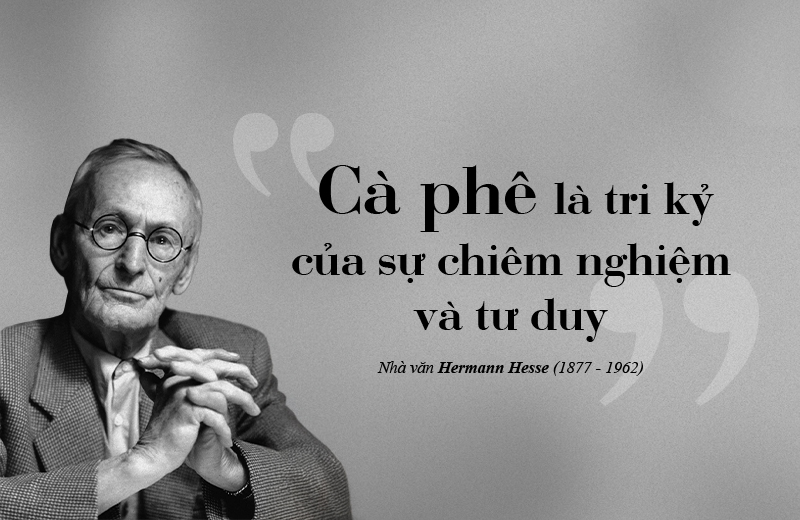
“Coffee is the companion of contemplation and thought.” — Writer Hermann Hesse (1877–1962)
Knowledge and Creativity — The Foundations of the Knowledge Society
Throughout human development, societies have been understood and categorized through various models depending on the perspective of analysis — whether economic (agricultural society, industrial society, post-industrial society) or civilizational (feudal society, modern society, knowledge society).
The concept of the “knowledge society” became more clearly established in the second half of the 20th century alongside the rapid advancement of science, technology, and information systems. UNESCO uses this concept to describe a model of society in which knowledge is widely created, shared, and applied in pursuit of sustainable and equitable development. In its 2005 report Towards Knowledge Societies, UNESCO emphasized that a knowledge society is not defined solely by technology or economics, but is also deeply connected to access to knowledge, freedom of expression, and the comprehensive development of human potential.
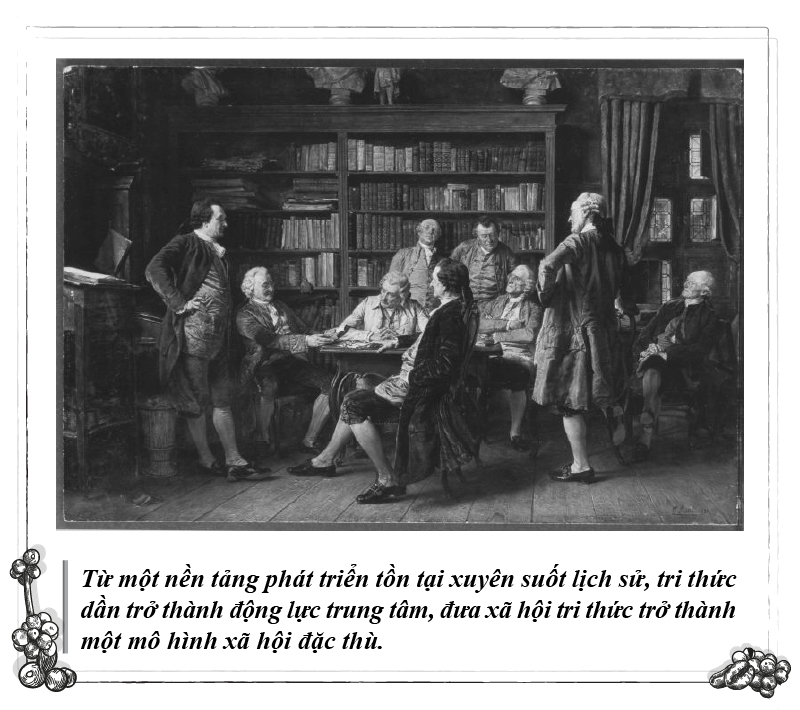
From a foundational force that has accompanied human development throughout history, knowledge has gradually become the central driving force of progress, leading the knowledge society to emerge as a distinct social model.
However, in essence, the knowledge society is not an entirely new phenomenon. Although it has existed throughout the development of human civilization, it was only recognized as a distinct social model once knowledge became the principal driving force of modern society. From the philosophical dialogues of ancient Greece that laid the foundations for rational thought, to the scientific achievements and foundational systems of knowledge developed during the Renaissance and the Enlightenment — which paved the way for modern science and industrial civilization — knowledge has consistently played a vital role in the advancement of humanity.
The central role of knowledge in social life has also been reflected in many influential scholarly works. In Novum Organum (1620), philosopher Francis Bacon championed empirical knowledge as the foundation of social progress through his famous assertion that “knowledge is power.” By the 20th century, sociologist Daniel Bell, in The Coming of Post-Industrial Society (1973), argued that knowledge had become the primary resource driving the transition from a production-based economy to a service- and knowledge-based economy. Meanwhile, management theorist Peter Drucker, through works such as The Age of Discontinuity (1969) and Post-Capitalist Society (1993), emphasized the rise of the “knowledge worker” as the central force of the modern economy.
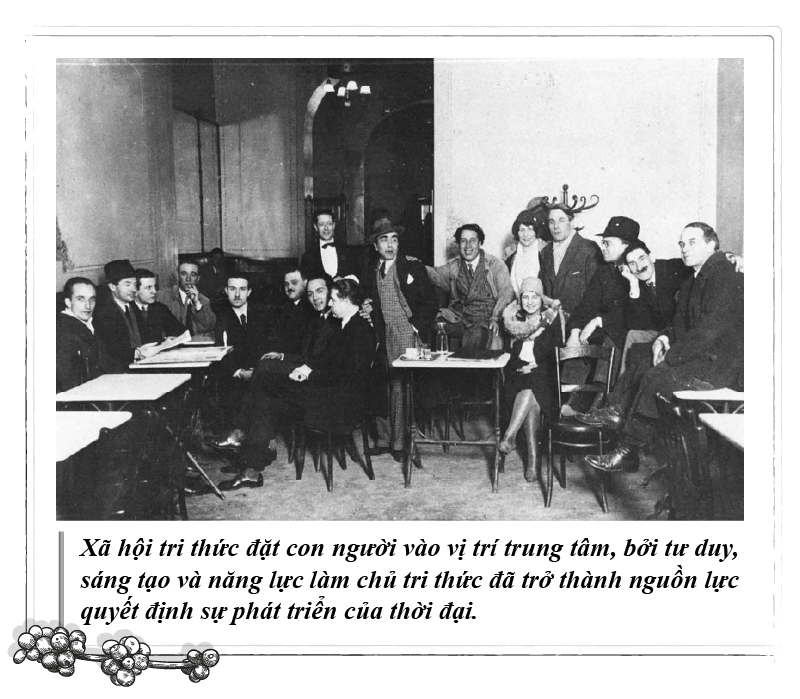
The knowledge society places human beings at its center, as thought, creativity, and the capacity to master knowledge have become the decisive resources driving the development of the modern era.
In the knowledge society, human beings no longer function merely as laborers or passive recipients of information; they become active participants in the creation, sharing, and construction of knowledge. Knowledge therefore does not exist as a closed system of values or as something transmitted in a one-way direction. Instead, it is continuously formed, expanded, and developed through dialogue, debate, critical reflection, and social interaction. It is precisely this ongoing process of exchange that generates new foundations of knowledge, driving innovation and the advancement of humanity.
It can be seen that the value of knowledge lies not merely in its accumulation or possession, but also in its capacity to circulate and be applied within social life. Through the freedom of exchange and active human participation, knowledge is continuously transmitted, renewed, and transformed into a driving force for the development of communities and humanity as a whole.
Coffee’s Imprint on the Development of the Knowledge Society
Originating in the East before spreading to Europe and eventually across the world, coffee — with its ability to foster alertness and create open spaces for free dialogue — became a source of creative energy and social connection. Coffee and coffeehouses opened pathways for discussion, research, and intellectual exchange, responding to humanity’s growing desire to acquire, create, and disseminate knowledge, while simultaneously driving the movement and development of the knowledge society.
In The Structural Transformation of the Public Sphere (1962), sociologist Jürgen Habermas highlighted the important role of coffeehouses as social spaces. According to Habermas, during the 17th and 18th centuries in Europe, a “public sphere” emerged — a space where individuals could gather, exchange ideas, and debate matters of common social concern through reasoned argument and rational discourse. Within this framework, coffeehouses became a crucial component of the public sphere, contributing to the formation of public opinion and the dissemination of knowledge throughout society.
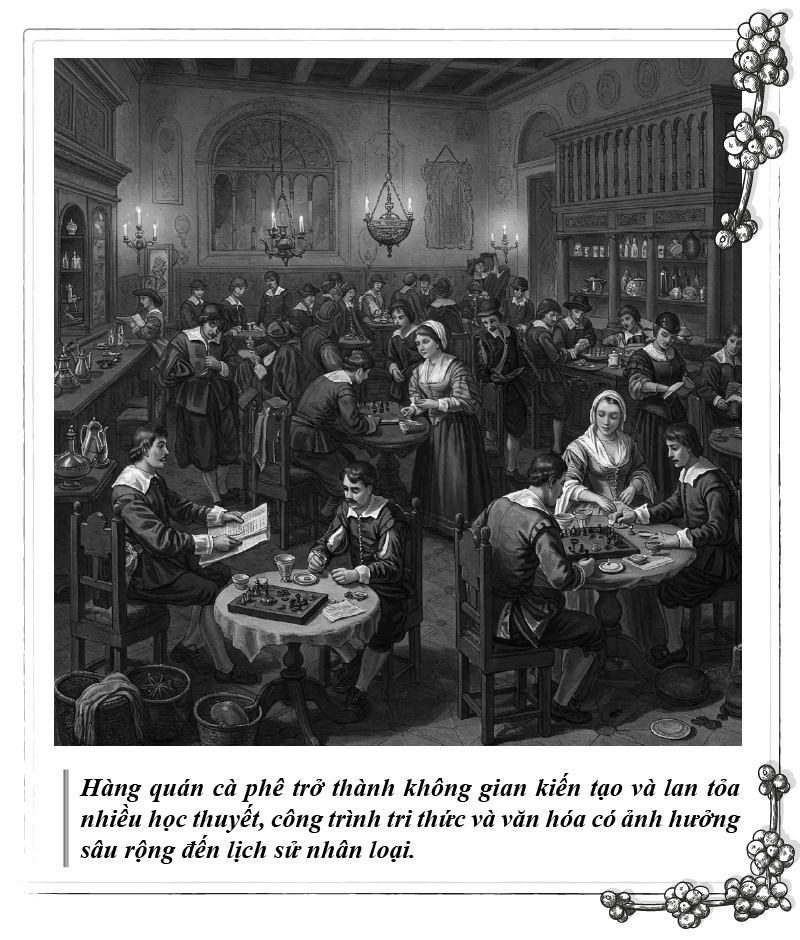
Coffeehouses became spaces where influential theories, intellectual works, and cultural movements were created and disseminated — leaving a profound impact on the course of human history.
From the 16th century onward, the first coffeehouse in Istanbul was known as Mekteb-i ‘irfan — “the school of wisdom” — a place where new ideas were introduced and disseminated throughout Ottoman society. When coffeehouses spread to Europe, they evolved into spaces for access to knowledge, freedom of expression, and social dialogue. They were celebrated as the “Penny Universities” in England, the “Sidewalk Academies” in France, and the “Free Universities” in Italy.
Coffeehouses became centers of academic, cultural, and social life in many countries, serving simultaneously as libraries, newspaper distribution hubs, gathering clubs for scholars and intellectuals, and spaces for debate and the emergence of new intellectual movements. These activities played an important role in advancing the development of the knowledge society.
In Italy, Caffè Giubbe Rosse was the birthplace of literary journals such as Lacerba and Solaria, both of which played important roles in advancing modern Italian literature. In France, Café Procope became a gathering place for French intellectuals who debated ideas and collaborated on the compilation of the Encyclopédie — the influential encyclopedic work that profoundly shaped both the Enlightenment and the modern era. In England, London coffeehouses were closely associated with the discussions of Benjamin Franklin on science, journalism, and social issues, helping disseminate Enlightenment ideals, freedom of expression, and civic consciousness within modern society.
Meanwhile, over cups of coffee, philosopher Voltaire wrote some of the defining works of the Enlightenment era, including Candide and Letters on England. Philosopher Jean-Jacques Rousseau further developed influential ideas on freedom, education, and the social contract, while composer Johann Sebastian Bach — a well-known coffee enthusiast — created Coffee Cantata, a lively reflection of secular European life in the 18th century.
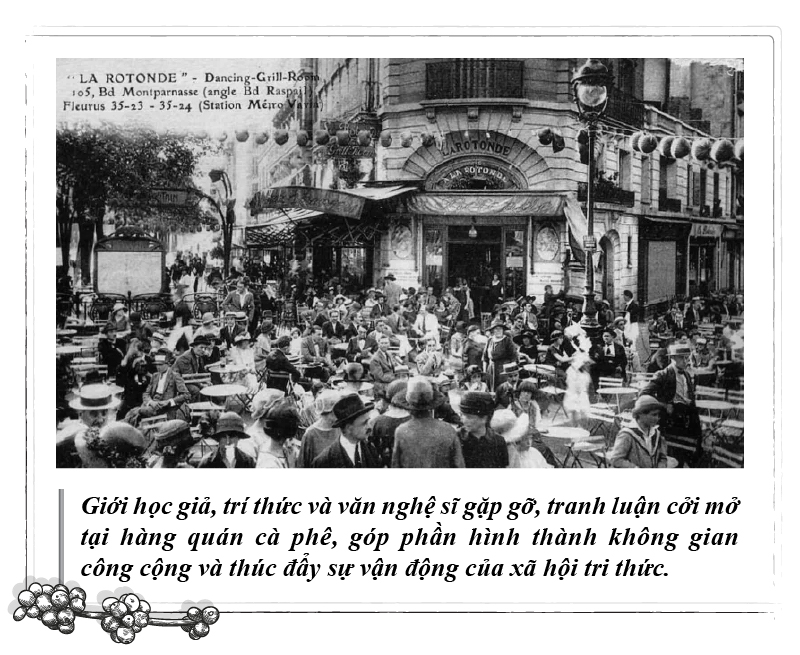
Scholars, intellectuals, and artists gathered in coffeehouses to engage in open debate and exchange of ideas, contributing to the formation of the public sphere and advancing the development of the knowledge society.
In the 20th century, as knowledge and creativity increasingly became the central resources of modern society, coffee and coffeehouses continued to play an important role in shaping social life. Les Deux Magots and Café de Flore became familiar gathering places for philosophers, writers, and artists such as Jean-Paul Sartre, Simone de Beauvoir, and Albert Camus — figures who profoundly influenced existential philosophy and modern humanist thought. Meanwhile, the cafés of Montmartre served as meeting points for renowned painters such as Vincent van Gogh and Pablo Picasso. At the same time, Café Central attracted intellectuals including Sigmund Freud, Leon Trotsky, and Stefan Zweig, contributing significantly to the intellectual, literary, and political life of 20th-century Europe.
Most notably, through the dialogues, debates, and exchanges of knowledge that unfolded within coffeehouse spaces, people not only gained access to new information and ideas, but also gradually developed independent thinking, critical reasoning, and creative capacity — qualities that became essential driving forces behind the growth of the knowledge society and the advancement of modern civilized life.
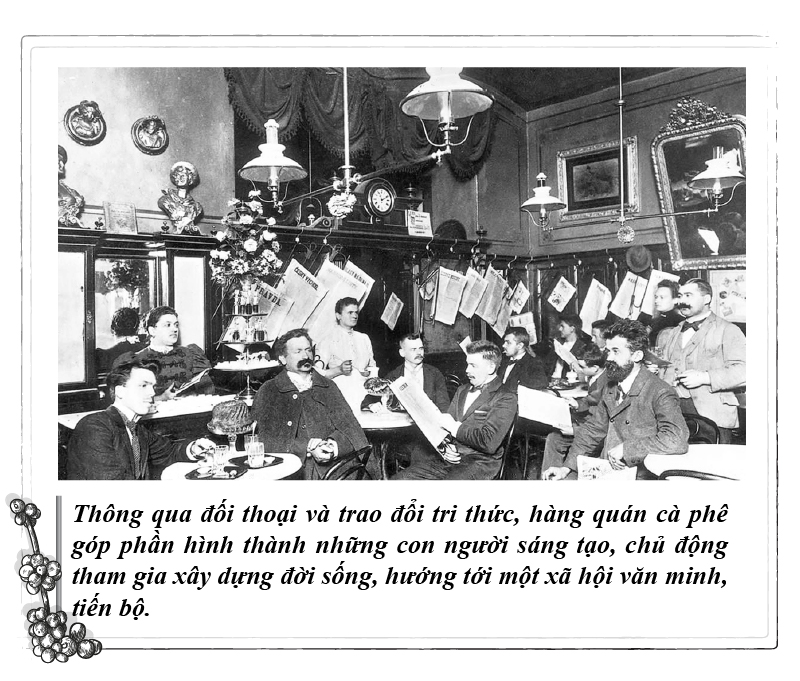
Through dialogue and the exchange of knowledge, coffeehouses have helped cultivate creative individuals who actively participate in shaping society, contributing to the pursuit of a more civilized and progressive world.
Drawing upon extensive research into coffee culture, Trung Nguyên Legend Group has developed distinctive and uniquely curated coffee spaces positioned as “Places Where Great Minds Gather.” Accompanied by exceptional energy coffee and the “Life-Changing Foundation Bookshelf” — a collection containing the essence of humanity’s intellectual heritage — Trung Nguyên Legend coffeehouses have become spaces that inspire the cultivation of knowledge and creativity in contemporary life, connecting individuals who are passionate about learning and driven by aspiration. As noted by the Financial Times, these spaces have “become important social hubs.” Among them, initiatives such as Saturday Coffee, Creative Spaces, and the The Coffee World Museum stand out as unique coffee spaces dedicated to knowledge, culture, and the arts within the Trung Nguyên Legend ecosystem. These venues have been recognized by the British Council as truly “creative cultural spaces.”
Most notably, by bringing together the essence of the world’s three great coffee civilizations — Ottoman, Roman, and Thiền (Meditation) — Trung Nguyên Legend coffee spaces continue to cultivate and elevate the cultural values of both Vietnamese and global coffee traditions. Through this vision, they are gradually shaping a new philosophy of life that encourages mindful thinking, creativity, and human connection, contributing to the advancement of a more enlightened and civilized global society.

Trung Nguyên Legend coffeehouses foster mindful thinking, creativity, and the exchange of knowledge, contributing to the advancement of a more civilized and enlightened human society.
Far beyond the value of an ordinary beverage, coffee and coffeehouses have become enduring symbols of dialogue, creativity, and intellectual freedom. Throughout the evolution of social structures — particularly within the development of the knowledge society — coffeehouses have served not only as places where people gather and exchange ideas, but also as spaces that inspire thought, elevate creativity, and contribute to the advancement of human civilization.
Coming Next: The Aesthetics of Coffee Brewing Tools and Craftsmanship