


ARTICLE 116: COFFEE’S IMPRINT ON HISTORICAL STUDIES
Beyond advancing the development of historical studies, coffee has also been an essential force in shaping the history of human civilization itself.
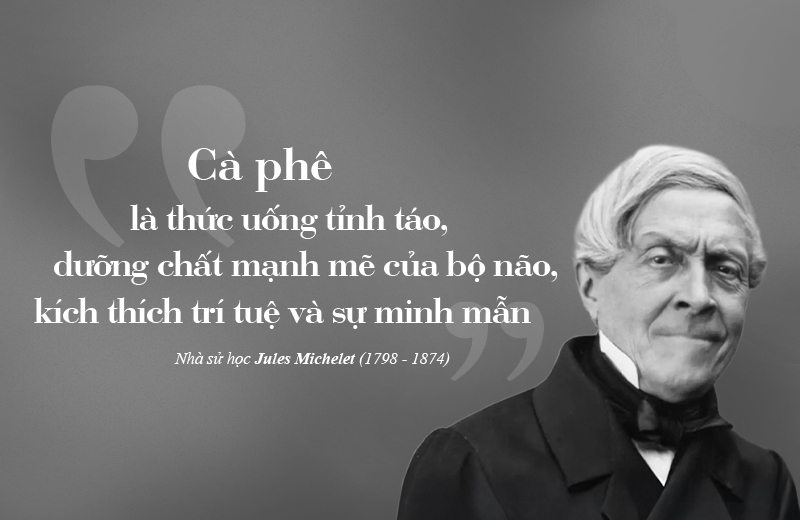
Coffee is a drink of awakening, a powerful nourishment for the mind that stimulates intellect and clarity.” Historian Jules Michelet (1798–1874)
Historical Studies: Understanding the Past, Shaping Humanity’s Future
Historical studies have existed since ancient times, initially taking the form of oral traditions or records inscribed on stone, papyrus, and other early materials. Their purpose was to preserve collective memory, gradually replacing myths and legends while offering moral and political lessons for rulers and societies. Before the 17th century, however, history remained deeply intertwined with literature and mythology, relying heavily on subjective interpretation and narrative storytelling rather than critical analysis.
The Age of Enlightenment marked a profound turning point for the discipline of history. As humanity increasingly embraced reason, science, and the pursuit of happiness as pathways to improving society and human life, historical studies underwent a significant transformation. The rise of rationalism, the printing revolution, and growing interest in humanity’s role within society fueled the demand to explain the past — particularly the origins and dynamics of human civilization — through scientific inquiry rather than supernatural explanations.

A historical manuscript by the ancient Greek historian Herodotus — representing the period when history was first recognized as an independent intellectual pursuit, moving beyond the framework of mythology and laying the foundation for systematic historical research methods.
In this transformation, historical studies evolved beyond merely recording the past to become a vital force shaping the future of human civilization. German historian Leopold von Ranke (1795–1886) laid the foundations of modern historiography by advocating research grounded in accurate archival sources, with the goal of reconstructing the past “as it actually happened” through rigorous objectivity. Most notably, the seminar model and methods of source criticism that he introduced into universities marked a historic turning point: from the 19th century onward, history formally separated from literature and philosophy to emerge as an independent academic discipline.
With the advancement of science, economics, society, and academic systems throughout the 19th and 20th centuries, humanity began approaching the past through increasingly diverse perspectives. Historical studies gradually expanded both in scope and methodology — moving beyond political events to encompass social life, economic structures, cultural developments, and the everyday experiences of ordinary people. Various schools of historiography emerged, including positivism, the Annales School, and Marxist historiography, transforming history into an interdisciplinary field capable of interpreting the past at both macro and micro levels. Consequently, the world came to be understood through the lenses of economic structures, trade exchanges, and networks connecting communities and nations. At the same time, the expansion of transcontinental trade routes and the movement of people, goods, knowledge, and technology helped shape a more interconnected and global understanding of history.

Historical studies are not merely a discipline devoted to understanding the past, but also a vital force in shaping the future of human civilization.
From simple chronicles and narrative accounts, history has evolved into a scientific discipline that reconstructs and interprets humanity’s past, enabling deeper understanding of the interwoven nature of civilizations and the significance of the past to humanity’s shared future. Through historical studies, people gain clearer insight into the dynamics of social development, as well as the achievements and mistakes of previous generations. These lessons from history provide valuable guidance for building a more prosperous and fulfilling society for the future.
Coffee’s Imprint on the Course of Human Civilizational History
Introduced to Europe in the 17th century, coffee quickly became a source of energy that awakened thought, guiding people toward the clarity of reason and helping usher in the Age of Enlightenment. In this context, coffeehouses emerged as symbolic spaces of scientific inquiry and critical thinking — serving as vibrant cultural centers and intellectual forums for dialogue among Europe’s scholars and thinkers.
Free from the pressures of both state authority and the church, coffeehouses also functioned as centers of information and communication, where newspapers and news on economics, maritime trade, and politics were continuously circulated and discussed. These cafés attracted philosophers and historians alike, who gathered there to observe social life, document events, engage in analysis, and exchange ideas through open debate and intellectual discourse. Within this atmosphere of openness, historical knowledge flourished. Diverse schools of thought and historical theories emerged, reflecting the rhythms of a rapidly changing world. As a result, historical studies entered a process of scientific development, adopting more rational and systematic approaches grounded in social observation, debate, and critical thinking.
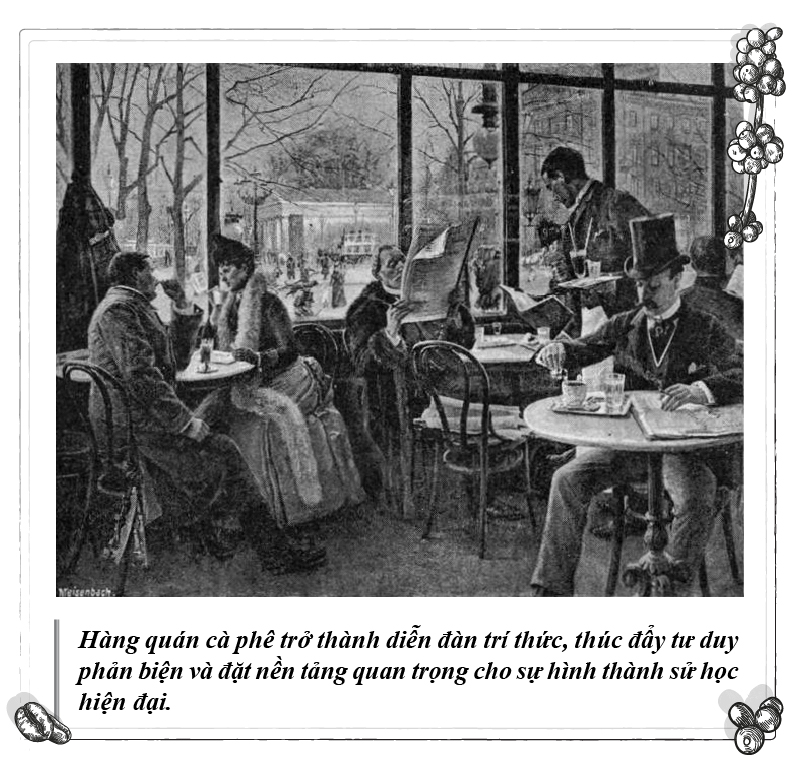
Coffeehouses became intellectual forums that fostered critical thinking and laid an essential foundation for the emergence of modern historiography.
Among the most prominent was Café Procope in Paris, a gathering place for thinkers such as Voltaire and Denis Diderot, who engaged in debates that helped shape key principles of modern historiography, including evidence-based inquiry, comparative thinking, and scientific skepticism. Likewise, Karl Marx frequently visited cafés in Berlin and Paris to exchange ideas with progressive intellectuals, experiences that contributed to the development of his theory of historical materialism — a framework that would profoundly influence 20th-century historiography.
Most notably, coffee was not merely the preferred beverage of historians and philosophers; it also became an important subject within the study of global history itself. Research into coffee’s origins, consumption culture, trade networks, and shifting centers of power reveals the profound influence coffee has exerted on economic, social, and political transformations across the world over centuries. The history of coffee is therefore far more than the story of a beverage. It is also a narrative of the economic, social, and political evolution of human societies — a story intertwined with power, social structures, international trade, and the rise of the modern global economy.
From a humble bean first discovered in Ethiopia in the 9th century for its awakening effects, coffee evolved into a global commodity with profound influence on economic, social, and cultural life. It also helped pave the way for the emergence of fair trade movements and sustainable development practices. Throughout this journey, coffee became deeply intertwined with transformations in human consciousness, shifts in global power, the expansion of globalization, and the formation of international trade networks.

The historical development of coffee is a cultural and social phenomenon that reflects the spirit of each era, while also helping explain how humanity interacts, innovates, and builds civilization.
Coffeehouses — from their role as vital social spaces within the Ottoman Empire to their evolution into hubs of social connection and intellectual exchange among European thinkers — became ideal environments for the emergence and development of movements and ideas that propelled society toward greater progress. Taking coffeehouses as a subject of historical inquiry, Fernand Braudel (1902–1985), a leading figure of the Annales School, viewed cafés as symbols of urban life and the rhythms of economic and social activity. Braudel was particularly interested in how coffeehouses reflected material life and social structures, offering deeper insight into the economic and cultural transformations of an increasingly globalized world. In this sense, coffeehouses were more than gathering places; they became civilizational institutions that influenced multiple dimensions of human life simultaneously, contributing to the shared heritage of human civilization.
In today’s knowledge-based economy, coffee’s values of creativity and mindful awareness continue to flourish, helping shape the way people think, act, and envision a more sustainable future.
Coming Next: Coffee in the History of Globalization